Showing posts with label local food. Show all posts

Sunday, January 8, 2012

Economy and Agriculture: The Future


As I explained previously, the number of farmers and folks who live on farms is at an all time low in this country, having dropped from 90% in 1790 to less than 1% today. Why is that, exactly?

Well, the way conventional farming works these days makes it very hard to make a living just by being a farmer. According to the EPA, 40% of farmers list another occupation other than farming, and another 14% of farmers are retired. The implication is that farming is just not that lucrative.

Au contraire, says the Leopold Center for Sustainable Agriculture. According to a 2010 study of theirs, farming can have quite the economic impact for a region... but you have to do it right. 

The study analyzed the impact of expanding fruit and vegetable production in six states in the upper Midwest (IL, IN, IA, MI, MN, WI). The study looked at 28 different fruits and vegetables, but did not include crops that are already being grown in ample quantities (e.g. sweet potatoes, corn and apples). The study examined two different scenarios. The first looked at the economic impact of increased production on the farm level; the second scenario at the impact of increased production for 28 metro areas in and around the six states.

In the first scenario, the study found:
  • Increasing production of 28 fruits and vegetables in the six states could mean $882 million in sales on the farm level, more than 9300 jobs and $395 million in labor income. 
  • If half the increased production were sold in producer-owned stores, this would mean 1405 establishments, 9652 employees, and over $287 million in labor income.
  • Only 270,025 acres would be needed to grow the needed produce, roughly the same as the cropland in just one of Iowa's 99 counties.
  • The job gains would be significantly higher than the number of jobs produced by the same number of acres under conventional production. For example, increased fruit and vegetable production in Iowa would result in 657 farm-level jobs, compared to just 131 jobs currently available with the same land under corn and soybean production.

In the second scenario, the study found:
  • Increased fruit and vegetable production for the 28 metro markets would result in more than $637 million in farm-level sales and 6694 farm-level jobs - there are currently only 1892 jobs available under corn and soybean production in the area.
  •  An additional 6021 jobs would be created due to the farmer-retail direct economic impact of the increased production.

Here's what I take away from this study: there is no substitute for diversified farming. Growing a large number of different crops not only makes a farm more marketable to consumers (who wants to just buy corn all the time?), but insures that if you have one crop fail due to a poor year, you have a back-up with your remaining crops.

Also, diversified farming is far better for soil health - growing the same crop in the same area will deplete the soil of necessary nutrients. Not to mention, the deer will know exactly where to find your green beans. Tricky devils.

So now we can agree: farming can, in fact, be enough to make a living. But there are still obstacles for those who are trying to make it in the farming business. So stay tuned in the days ahead for Part III!

Thursday, August 25, 2011

From Farm To Table: A Local Tour

It has been a very Farm To Table week here in Virginia.

Herb garden at the Clifton Inn
For the uninitiated, Farm To Table is a local food movement that aims to get food from small farms onto the tables of local consumers through their homes, their schools, and their restaurants.

Probably the most famous example I can think of offhand is Chez Panisse, a restaurant in Berkley, CA that was started in 1971 by Alice Waters.* The notion of a restaurant where all the food was grown locally and organically was pretty radical at that time, but the movement has been slowly and steadily gaining ground and has enjoyed a pretty significant upsurge in the last decade or so.

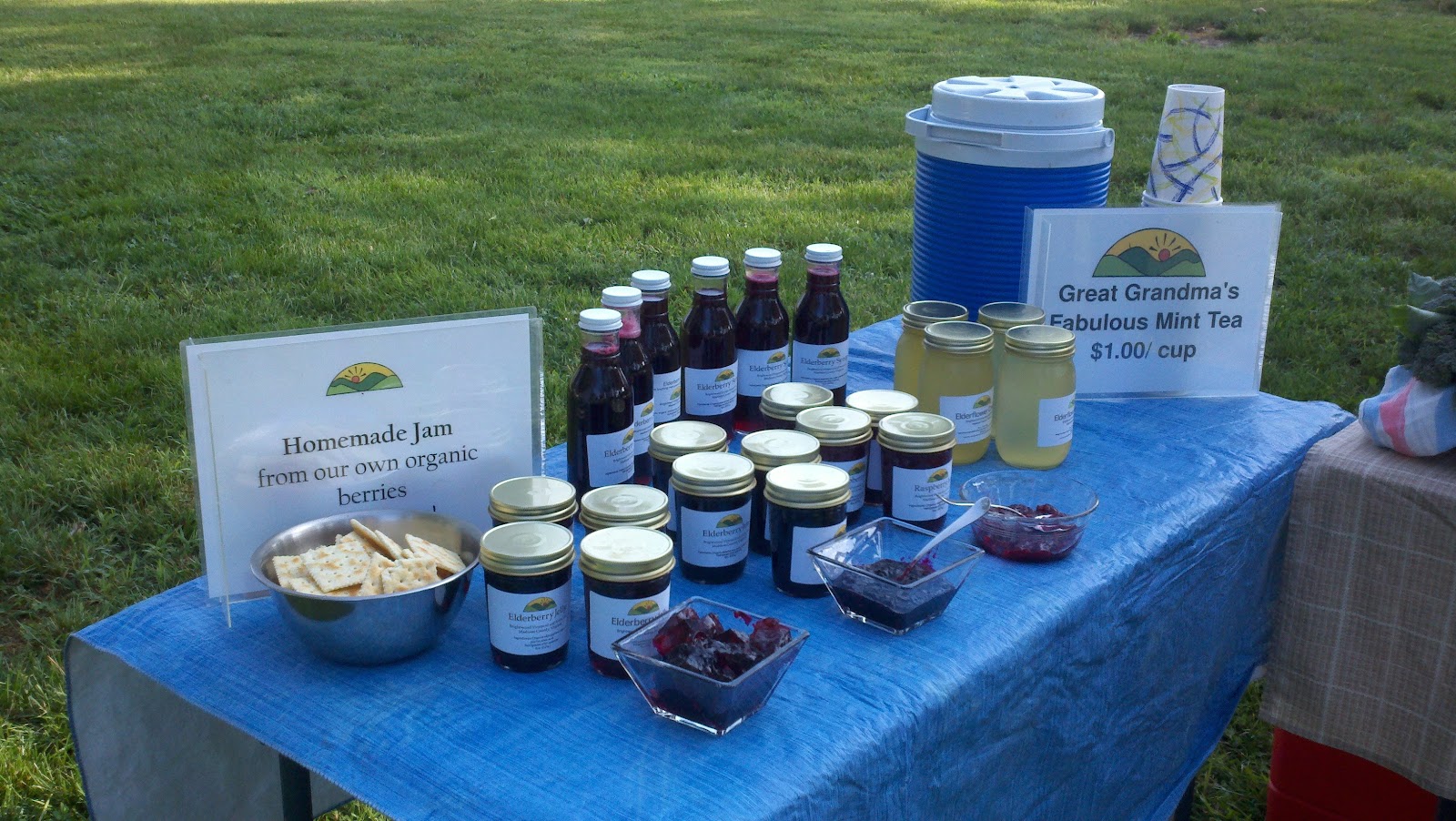
Last week, the Madison County Farmers Market put on a "farm to table dinner" to benefit the market. Farmers from the market - including us - donated food for a practically 100% local meal. The dinner was held at Prince Michel Winery, who (predictably) provided the wine. Brian, Autumn and I volunteered as servers, along with several other local farmers who work the market.


Then the very next morning, I drove down to Charlottesville to visit the Clifton Inn, a B&B slash restaurant. One of the chefs there buys produce from us occasionally, and had offered to give me a tour of the grounds and the gardens, where he grows some of the produce the kitchen uses. So I went. And he did.


Although the garden was a little smaller than I was imagining, it's exactly the sort of thing I love to see a place like that doing - growing their own food, and sourcing some of their produce locally. A lot of people - everyone from individual consumers to school cafeterias to restaurants - are intimidated when they hear about places like Chez Panisse, who grow and/or buy all of their food locally. But it's okay to start small - growing a squash plant in your back yard, potting a few herbs in the windowsill, visiting the local farmers market and buying a few things a week. I recently read about a school district in Virginia that has the goal of buying 8% of their food locally this year, and gradually increasing that amount to 25% over the next two years. That sounds a lot more feasible than attempting to immediately grow 75% of your own food.

Another bit of Farm to Table news from this week has been the initiation of the newest AmeriCorps program, known as FoodCorps. This inaugural program aims to work with schools to educate youth about nutrition and food, build and tend school gardens, and get more fresh, local produce into school cafeterias.

Ah, if only I were younger and had fewer years of AmeriCorps under my belt.


*Incidentally, Alice Waters was just interviewed on Fresh Air to celebrate 40 years of her career in the local food movement.

Friday, August 12, 2011

Eggplant Galore

As mentioned in my last post, the Nightshade family is coming in droves right now. That means we have eggplant, and lots of it.

I'm sure many of you have met some of my eggplant friends already. But in any case, here's a little picture tour of our 90 foot eggplant row.

Berenjena
Rosa Bianca
Imperial Black Beauty
Listada di Galidia
Eggplant has been interesting to cook with, and I've had some definite failures that landed me in Mush City. But there were two notable successes recently. The first was Seared Eggplant "Steaks", which I served with a reduced elderflower wine sauce with garlic and parsley. Not as weird as it sounds, I promise.

The other was Eggplant Parmesan:


Not the best picture (forgot to get one before everyone dug in), but whatevs. The weird green things on top are fresh basil leaves. Next time, I'll probably put them on about five minutes before serving so they won't look so decrepit... they did taste very nice and aromatic and basil-y, however. So I'm not too concerned about it.

Incidentally, I made the eggplant parm with fresh tomatoes ALL from our farm. The basil's ours too. I used a mixture of eggplant - a little of everything except the Berenjenas, which I hear are better for stir-fry. The Imperial Black Beauty in particular baked well, and was incredibly sweet and delicious. 

Monday, June 27, 2011

Local Meal in the Vineyard

Saturday night, we enjoyed the company of several friends of the farm as we celebrated summer with dinner in the vineyard.


Guests brought food, of course - mostly appetizers and desserts, which were all (of course) delicious. But as a result, the meal was almost entirely from the farm!


Starting from the top left: Beet Salad (Autumn), Gnocchi with basil pesto (Brian, with Autumn and myself rolling and shaping the dumplings), Roasted Goose (Susan), beet chips (from a local store called Yoder's) and Marinated Swiss Chard (me). Not pictured: Pear Wine (Dean).


It was a beautiful evening, and a wonderful chance to eat a local meal together as a community. This is how a meal should be - a gathering, a communion and a celebration, rolled into one.

Wednesday, June 8, 2011

To Market, To Market

Saturday morning is the hallowed time of farmers markets for small family farms from coast to coast, and Brightwood Vineyard and Farm is no exception.


Usually I go help Susan at the Charlottesville Farmers Market, which is down in (can you guess?) Charlottesville. But this weekend was different - I went to the Madison Farmers Market, a mere five miles away from the farm, to help Autumn set up.


The Madison Farmers Market started just three years ago, and judging by the jump in sales this year, it's really starting to take off. According to Dean and Susan, it was rare to break $100 at that location in the past. Not too hard to imagine why... it's a small market in a rural area, where lots of people grow their own food and there's not a lot of attention paid to eating local, organic fare. However, this year the market has been pulling in around $175 or more regularly... and, quite often, more.


Autumn has more or less taken the Madison Farmers Market on as her project. She has quite an impressive background in management and food services (coffee, specifically), so I don't know how much of the jump is due to her enthusiasm and marketing savvy, and how much is due to the market's growing prominence in the area. It's probably a bit of both.


One of the nice things about having two such different markets - one small and rural, one large and urban - is that the shoppers at those markets are interested in very different things, and we can allocate our different products accordingly. Vegetables do very well in Madison, for example, so if we only have a few bunches of radishes, Madison gets them. On the other hand, few people in Madison are willing to pay $5 a carton for eggs, so the lion's share of those go to Charlottesville. Folks in Charlottesville go absolutely mad for herbs, but in Madison? Not so much.


Perhaps most importantly, the Madison Farmers Market is a valuable venue for being involved in the local community. It's not only a way for the farm to get to know its customers, but to also meet other local farms and develop connections with them.


After all, isn't that supposed to be the point? We want consumers to be engaged with their food, to know where it comes from and to question it. ("Hello, I was just wondering if you feed your cows chicken blood?")

We want people to invest money in their own communities, not send it to remote corporations in NYC, LA, or across the ocean. And the more consumers visit small, local farmers markets and buy food from small, local farmers, the closer we inch to taking back our food, our power and our lives.

Saturday, April 9, 2011

Farming, Community, Life: My take on The Greenhorns


Thursday evening, I had the opportunity to attend a screening of the new documentary The Greenhorns, produced by the grassroots nonprofit The Greenhorns, and which I first learned about a few months ago.

Greenhorns is a nonprofit that provides information and resources for new farmers. In the documentary, the Greenhorns founder Sevarine von Tscharner Fleming travels the country, interviewing beginning farmers,* as well as some big names in the field, like Michael Pollan (The Omnivore’s Dilemma, In Defense of Food: An Eater’s Manifesto) and Eric Schlosser (Fast Food Nation).

These new farmers, or “Greenhorns,” (see what they did there?) range in age from 18 to their early 60’s, and span the US from coast to coast. They are married and single, with children and without. They grow greens on city rooftops and raise cattle on rural family farms. They rejuvenate empty lots and provide produce for food deserts, balancing the tasks of introducing the joys of local food to consumers of all ages while working to learn the basics of keeping a farm running.

Their stories are all truly inspiring. But I’m not going to write about their stories, because it’s already been done – and very well indeed – by Ms. Tscharner Fleming. 

Instead, I want to talk about a theme that pervaded the Thursday night event: community.

First, let me give a brief summary of how the evening ran. When I arrived, I realized I actually knew a few people – there were several interns who are participating in other Piedmont CRAFT farms, who I met at the Sharondale mushroom farm tour. We spent an hour sitting on the grass outside, enjoying the historic and picturesque Morvin Farm, eating a dinner thoughtfully provided by Whole Foods and comparing our various farm apprenticeship experiences. After the screening, there was a “Young Farmer Panel” featuring five relatively new farmers who live in the Charlottesville area.

Late in the Q&A session, one of the panel members quipped, “I became a farmer because I thought I wouldn’t have to interact with people, but I talk to more people every day now than I’ve ever had to before!” Which got me thinking about the sense of community a small family farm creates in its wake.

Once upon a time, America’s countryside was dotted with small, healthy communities – at least, healthier than today. Folks got their food from local family farms, they bought their goods at locally-owned stores, and they weren’t afraid to lean on their neighbors for help.

Today, most of America suffers from what I like to call Cowboy Syndrome – the thought that every man (or nuclear family unit) is an island, and must be as self-reliant as possible. Which is just plain sad. How many moms feel comfortable asking their neighbors to watch their kids for an afternoon? How many people are okay with going next door to borrow a cup of sugar? Too few, I’m sure.

For a small, local farmer, isolation is completely unattainable. As our intrepid young farmer explained, you are constantly interacting with others. Susan and Dean’s home, for example, is constantly revolving with with WWOOF-ers, part-time workers, cottage guests, neighbors dropping by, travelers hoping to check out the winery, college professors examining how the farm copes with soil erosion, the local vet checking the donkey’s hooves… the list goes on and on. Merely starting a small, locally based farm will draw others to you, like small children to an open cookie jar.

While family farms are like small communities in and of themselves, they also play important roles locally – they purchase what they need from other local businesses, while providing fresh food for local families.**

All this crossed through my mind as I understood that, there in the horse barn where the documentary was screened, we were creating our own community: a community of young people, young farmers, a movement of those of us invested in creating justice, health, and sustainability through good, local food.

And as we ate our vegan pasta salad, comparing heirloom tomato seeds and laughing about nighttime chicken raids, I realized that we are building bridges to one another. We, the next generation of farmers in America, are creating relationships that we will use to strengthen our communities, our farms, and ourselves... even if all we need is to borrow a cup of sugar.


* According to the USDA, we learn, “Beginning Farmer” means anyone who has been farming fewer than 10 years.
** At least, that’s how it’s supposed to work. Walmart sort of messed this up.

Monday, March 14, 2011

Mango Chutney Madness

Due to an abundance of mangos in last week's Green BEAN box, I decided to ignore the obvious impossibility of mangos in Indiana in March (or EVER), and go balls out by making an exotic mango chutney.*

I looked at a few different recipes online before making my decision. Most of the recipes had what seemed to me to be an appalling amount of sugar - up to 2 cups, in one case. The original recipe I used called for half a cup of brown sugar, which I further reduced to a third of a cup. Mangos and raisins are sweet naturally, and along with the apple juice I figured the chutney would be cloyingly saccharine enough to suit even my sweet tooth.** I was also lacking a few ingredients (e.g. fresh ginger), but I made do with what I had available in the pantry.


 Courageous Mango Chutney

Ingredients
3 fresh mangos, ripe but not too soft
3 tbsp olive oil
1 tsp red pepper flakes
1 medium red onion, diced
1 cup apple juice
1/2 cup cider vinegar
1/3 cup brown sugar
1 1/2 tbsp yellow curry powder
1 1/2 tsp ground ginger
1 tsp ground cinnamon
Salt and pepper
1/2 cup raisins


Cut the mangos into medium to large chunks.

In a 12-inch skillet, heat the oil until shimmering. Add red pepper and stir until fragrant. Add onion and cook, stirring occasionally, until soft. Add mango and let cook for one minute.

Seperately, mix the apple juice, cider vinegar, brown sugar, curry powder, ginger and cinnamon. Add to skillet and bring to a slow simmer. Let simmer for about 30 minutes, until juice mixture has reduced to a sauce. Stir frequently.

When chutney has reached the desired consistency, add salt and pepper to taste. Stir in raisins and serve. 


This recipe would be really good on pork chops, roast or pan-fried chicken, and some types of fish. I paired it with baked tilapia - my parents really liked it, but I thought the tilapia was a tad bland. Maybe grilled or pan-fried. At any rate, the chutney itself was very good, and just sweet enough. In the future, I'll make extra and jar it for future use, or to use as gifts.

Additionally, next time I will not serve mango chutney on yellow plates. My food presentation skills leave a lot to be desired.


*Once again, fail to Green BEAN Delivery for sending us food that is neither seasonal nor local. These were from Peru, for crying out loud. However, since I love mango chutney, I choose to magnanimously forgive them.

**As a child, I was caught in the bathroom, eating sugar by the spoonful. Multiple times.

Wednesday, March 9, 2011

The Butcher, The Baker, The Boeuf Bourguignon Maker

For a while now, I have had a hang-up about boeuf bourguignon. Julia Child's boeuf bourguignon, to be precise. I somehow came to view mastering this recipe as a vital step in the career trajectory of any serious foodie. I'm not quite sure how this happened, but it was probably somewhere between reading Julie and Julia and My Life in France.

I - and many others, I believe - have come to view Mastering the Art of French Cooking as the First Edition Foodie Bible, the embodiment of the original Good Food movement. Maybe MtAoFC was considered an entrance into the world of home cookery for housewives in the 1960's, but like a snowball rolling down a hill, it has gathered force and mass as it raced through the next fifty years. This book has weathered TV shows, newscasts, best-selling memoirs, The Julie-Julia Project, and a major motion picture starring Meryl Streep, for crying out loud. A humble little cookbook it certainly is not... not anymore, anyway.

Bouef bourguignon is well known as traditional French fare, and is now even considered haute cuisine.* As such, it does not come without baggage, historically and culturally speaking. When the manuscript for MtAoFC first came across editor Judith Jones' desk, she settled on boeuf bourguignon as her test recipe. In the introduction to my own 40th anniversary edition of the cookbook, she explained with no small amount of gusto:
I ran home to make the recipe - and my first bite told me that I had finally produced an authentic French boef bourguignon - as good as one I could get in Paris. This, I was convinced, was a revolutionary cookbook...
And this from a lady who had lived in Paris for over three years.

Reading Julia Child's little love note before the recipe didn't really help settle my nerves, either:
As is the case with most famous dishes, there are more ways than one to arrive at a good boef bourguignon. Carefully done, and perfectly flavored, it is certainly one of the most delicious beef dishes concocted by man...
Perfectly flavored, eh? One of the most delicious concocted by man? No pressure.


I started at the butcher shop. Doesn't that sound quaint? There are a lot of reasons to frequent a butcher, which I won't go into right now, but the primary one is that it gives you the most control over selecting your meat, short of raising and slaughtering the animal yourself. I, of course, have additional ethical concerns, and I chose accordingly.

I decided to go with The Goose, an Indianapolis-based shop that specializes in local, naturally raised meat. They also have a coffee shop and sell delicious sandwiches, as well as artisinal cheeses, fresh seasonal produce, and dairy products from a local creamery. I got six ounces of bacon and three pounds of chuck roast, courtesy of Fischer Farms in Jasper, Indiana. Their cattle is grass-fed with a grain-finish, as the nice man who wrapped up my juicy-looking hunk of meat explained to me.


Back at the ranch - I hauled out the cookbook and re-read the recipe to make sure I had everything. Then I prepared all my ingredients in advance - cut my bacon into lardon and my three pounds of beef into two inch chunks, and sliced up all the vegetables I would be needing.


Of course, I had an audience.


Then it was a matter of blanching the bacon (that sounds like it should be a euphamism for something), browning the beef (ditto), sautéing the veggies, and dumping everything into a pot with a bottle of red wine, some beef stock, garlic, tomato paste, and a bouquet garni, which was provided free of charge by my friendly neighborhood butcher man. Wasn't he something?


Ultimately, I don't know why I was so nervous. It's time intensive, to be sure, but most of the time is spent just letting the whole pot simmer in the oven for a few hours. You can even make boeuf bourguignon in advance... Julia's recipe actually recommends it as a way to let the flavors mingle.


You might even have time to bake a little dessert. Lemon-lavender pound cake, if you're me.


In the end, it turned out perfectly. The sauce was just thick enough. The beef was tender to the point of perfection, falling apart on our forks and melting on our tongues. My parents, my brother, and my friend Abbie (who I invited along) all made many yummy noises. It might have been the wine speaking, but I'll pretend otherwise for now.


*This may or may not be according to Wikipedia.

Tuesday, March 1, 2011

My 2011 Goals and Sweet Potato Pecan Pie

As you may or may not remember, I've been hired by an organic farm for the 2011 growing season. First, I must get celebratory impulses out of my system, not unlike Colin Firth the other night.... so, YAY!
 
Or maybe I'll just celebrate with some PIE.
Now that I have that out of my system, I find myself wondering what role this blog is going to play in the upcoming year. I originally created it to chronicle my WWOOF-ing adventures, which have somehow morphed into accepting an internship on a family farm. My reasons for having this blog haven't changed much, though. And since I'm starting so soon - March 21st, to be precise - I want to take some time now and reflect on my goals.

Document my adventures, thoughts, experiences, etc. Just like a real diary... only a lot less private. I'll keep my own separate journal for my less public musings. Here, not only do I want to keep track of what I'm doing and learning every day, but I want to write about issues facing small family farms, organic and sustainable agriculture, food culture, and so on. All heavily seasoned with my own personal commentary, of course.

Hone my writing skills. While I love to write and think I'm pretty good at it, I know I have a lot to learn. A blog is as good a platform as any to practice writing regularly. Which brings me to...

Write regularly. When I keep a journal, I'm very good about writing regularly, but something - an inherent need for sleep, perhaps - often causes me to give up on keeping up to date when I get busy. And I'm sure this year is going to be nothing if not busy. So I'm setting a goal for myself to update this blog at least once a week. I'll revisit this after I start work, but I think this is a doable amount, leaving me plenty of wiggle room.

Run out of space on Picasa. What I mean by this hyperbolizing is, I want and need to do a great job of visually documenting this year, despite having a lardball of a digital camera to lug around. Besides, blog entries are so much more interesting when they have pictures accompanying them.... as anyone who compares my last few entries to a month or two ago can attest.


Now that all that seriousness is finished, let's talk about pie.

My grandad is visiting us right now and will be leaving soon, so I decided to make a gigantic dinner tonight, which was received with great acclaim. It consisted of pasta puttanesco and a spinach and fennel salad with strawberries and shitake mushrooms, topped with goat cheese and a floridly-colored homemade dressing that involved pureed strawberries.* And, to wrap up, a Sweet Potato Pecan Pie. Capitalized.

Nothing says "I love you, Grandpa!" like anchovies, garlic and salmon-colored salad dressing.
Here's the back story: last year, I had a Julia Child page-a-day calendar. Since I was living off the AmeriCorps $4.50 per day food budget, I couldn't try very many recipes, so I ended up saving them all. This weekend, I spent many an hour organizing the recipes, gluing them individually onto sheets of paper, cross-referencing them and putting them in a binder. I know it seems strange, but one thing you must understand about me is that I get weirdly excited about organizing things...especially if it involves color coding.
  
As I was putting the recipes in their nice, safe little page protectors, I happened to stumble upon one for Sweet Potato Pecan Pie. I like sweet potatoes, I thought. And I like pecans. And I LOVE pie. And wonder of wonders, I had all the ingredients, including sweet potatoes from the Indy Winter Farmer's Market. Unfortunately, I did have to resort to a frozen pie crust, for time was simply too short. But otherwise, the pie was a resounding success, and was absolutely perfect as a mid-winter dessert. Safe to say, the pie will be reappearing for Thanksgiving 2011.


Sweet Potato Pecan Pie

Ingredients
1 9-inch frozen deep-dish pie crust, thawed and pierced all over with fork
(Again, you can make your own crust. I definitely will next time. But this way is certainly time-saving.)
1 1-lb sweet potato, pierced with fork
1/2 cup packed brown sugar
2 tablespoons melted butter
1 tablespoon vanilla extract
1/2 tsp. cinnamon
1/4 tsp. allspice
1/4 tsp. salt
(Yes, I know it's the devil - you can substitute honey or sorgham or whatever you want. You can also boil water and sugar and make simple syrup.)
 2 large eggs
1 cup pecan halves

Preheat oven to 400 F and bake crust until pale golden, about 8 minutes. Set aside and reduce oven temp. to 350 F.

Cook potato in microwave on high until tender, about 6 minutes per side. Cut in half and scoop flesh into medium bowl and mash - measure out 1 cup and set rest aside. Whisk brown sugar and next 5 ingredients into mashed potato; spread mixture over pie crust.

Whisk syrup and eggs in bowl to blend, and stir in pecans. Pour over potato mixture.

Bake pie until filling is set, puffed, and brown - about 45 minutes. Let cool before serving.


*No, we did not go out and buy strawberries in February. What a notion. My parents get a co-op sort of deal through Green Bean Delivery, through which they get a box every week full of local, organic produce. At least, it's supposed to be local... they seem to have some difficulties in winter, and I've noticed a lot of items coming from Florida... kiwis, lemons, oranges, and the like. At least it's organic, although it raises questions. Check out the FRESH: The Movie blog for a discussion about what goes into a food mile, Part 1 and Part 2.