Showing posts with label animal processing. Show all posts

Saturday, October 15, 2011

In Which I Process Chickens

Hello, all! Yes, yes, I know. You thought I dropped off the face of the earth. What actually happened was that precisely one month ago, our wireless router completely fried. The promised replacement was supposed to arrive by October 3, but clearly that has not happened.

Anyways, that is my excuse. But I do feel terrible for leaving everyone in the dark for so long, so I thought for this first blog post in over a month, I should do something big. Something flashy. Something involving viscera.

Welcome to Chicken Processing Day, the 2011 Edition.* Make sure you have your gingham apron, because you are about to get dirty.

First, Brian ties the birds up by their feet, then kills them as humanely as possible by opening the arteries on the sides of the neck with a very sharp knife. Autumn and I were both very happy to let him do this part.


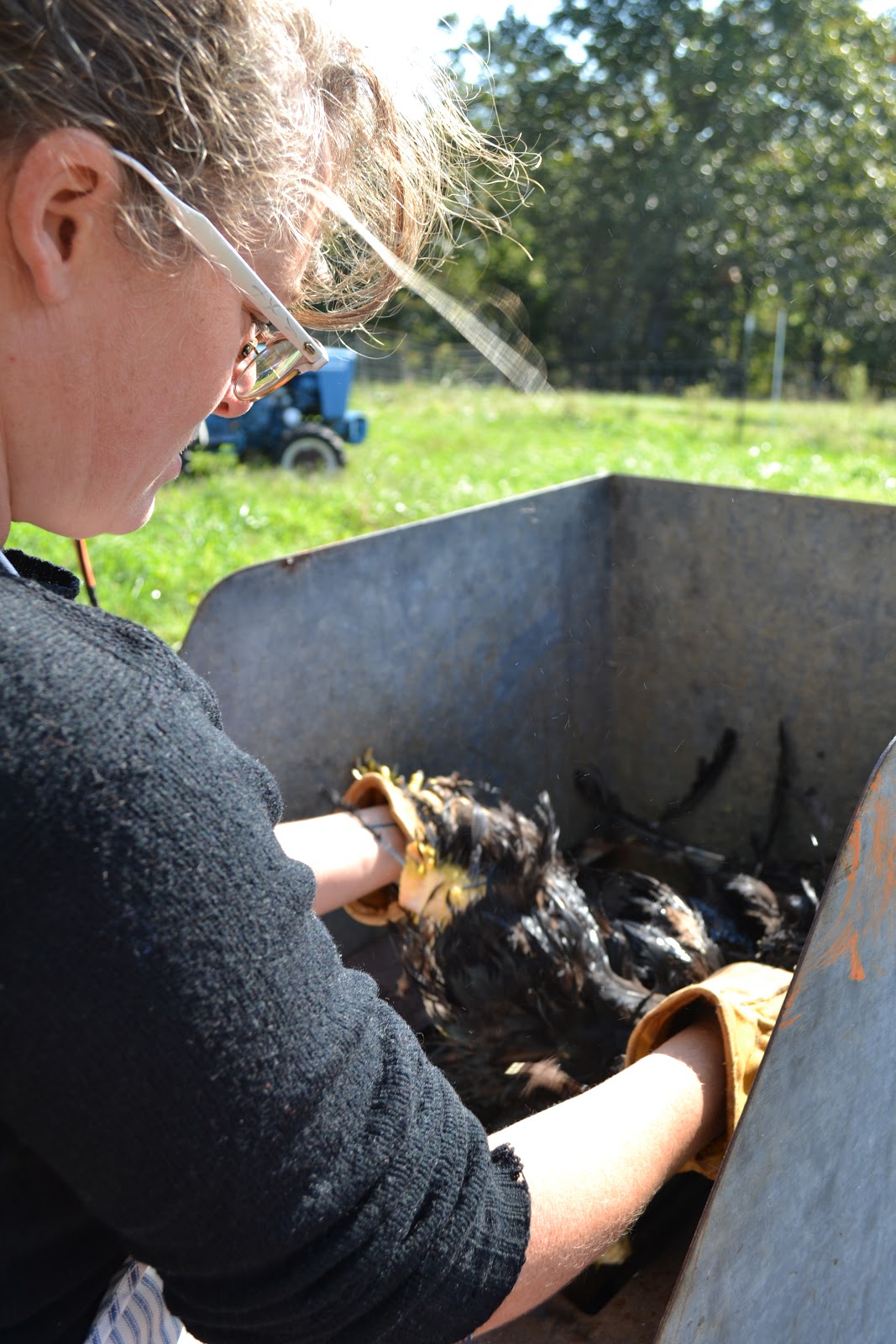
Then Caitlin scalds the birds by dipping them in 145 degree water for about a minute. This loosens the feathers so we can pluck them easily. You test them by plucking out some of the wing feathers. If they come out easily, it's ready.


Autumn and I were the pluckers for the day. The Featherman machines have rubber "fingers" that spin on a motor, which helps the plucking go much faster.


After all the killing and plucking was done, we put the birds in ice water to stay cold over lunch.


At lunch time, we relaxed and messed around with the barn cat.


In the afternoon came the "fun" part - evisceration. Brian started by removing the head, feet and crop from the bird. Then Caitlin, Autumn or I got to do the work of removing all its organs.


See that vivid shade of taxicab yellow? That is the color that chicken fat should be. These are pastured birds that are free to roam outside, eating grass and bugs and living the good chicken life. That fat is full of all sorts of nutritious and delicious stuff. And damn, does it taste good.

Also, the birds we processed were all three years old - pretty ancient for a laying chicken. Most large farms don't keep birds around after one year.


And sometimes, you might find a surprise.


*Actually, we processed chickens back in July too. But I didn't really get very many pictures that time.

Saturday, September 3, 2011

The Farm of Many Faces: Touring Joel Salatin's Grass Farm


It's hard to think of any farmers more famous than Joel Salatin. The owner of Polyface Farm, Salatin has been featured in Michael Pollan's The Omnivore's Dilemma and in the documentary Food, Inc. He has written numerous books, lectures far and wide,* and happens to give weekly tours on his farm, one of which we attended two weeks ago.

For those who aren't familiar with Polyface Farm, a little background: Joel Salatin describes himself as a "grass farmer". He pastures broilers, turkeys, layers, pigs and beef on his land, using intensive grazing methods. Salatin is not organic certified (see here), but he doesn't need to be. He's made a name for himself in the sustainable agriculture world. In fact, Salatin only sells directly to consumers at his farm, and to restaurants and buyers' clubs within a four hour driving distance of the farm.

Tours at Polyface Farm are very well attended, if my experience was any indication. Everyone loads onto a couple trailers that have been comfortably padded with straw bales, which Mr. Salatin then trucks around the farm with his big ol' tractor.

First stop: the broilers and the turkeys.


The broilers, as you can see, are kept in separate pens that are about ten by ten feet. They are moved across the field to a new spot every day, giving the chickens new grass and new insects to feed, but without leaving them in one area long enough to kill the field with their "hot" (i.e. nitrogen-rich) poop. The turkeys are moved every two days.


The pigs are kept in woods on Polyface's 550 total acres. They're moved about every two weeks, which is enough time to stir up the soil in the forested areas without killing the trees. According to Salatin, after being used as a pig run, this area will be far more lush and vibrant than if it hadn't been.


Salatin says they don't cut much hay...just what they need.


Salatin's so-called "Egg Mobile", where his layers are housed. He follows them about two days behind the cows, so the chickens can go through the cow dung and pick out parasites and flies, mimicking the symbiotic relationships between birds and some migratory animals in nature. By scratching up the cow droppings, the chickens also spread it around, making it a more effective fertilizer, and fertilize the fields with their own leavings as well.


The cows are moved every day. By grazing them within a smaller area, Salatin says they are forced to eat everything, not just pick and choose the nicest bits. The cows are grass fed and, in winter, put on hay - they are never given a corn-based diet.


If you've read or seen anything about Salatin, you know that he has a lot of stock phrases, and we got to hear them all. (If I were giving a tour a week and lecturing 100 days a year, I'd probably have some handy sound bytes too.) But despite that, he was certainly not merely reciting a memorized script. He was genuine and approachable, answering questions in detail, and no topic was off-limits.


Although the tour ended after the cows, we took a few minutes to explore around the farm. This is Polyface's chicken processing area. Because it is open to the air, the USDA has tried to shut Salatin down numerous times, saying the area doesn't conform to USDA standards. Somehow - through the forcefulness of his personality, perhaps - Salatin has managed to keep them back.


They process a lot of chickens. These chickens actually come from a satellite farm that grows and processes chickens for Polyface, and is run by a former intern.


Our last stop was the gift shop, which features quite a bit of meat products, as well as t-shirts proclaiming things like "Lunatic Farmer" and "Everything I want to do is illegal." Nearly everyone on the tour came armed with large coolers, which they then stocked with Polyface Beef, Polyface Pork, and Polyface Chicken. We were no exception.


*Salatin will be a keynote speaker at this year's Acres U.S.A. conference, incidentally.

Saturday, June 18, 2011

Death and the Farm


The overabundance of funerals in my family over the last month has me thinking about a lot of things, death naturally being one of them. When I returned to the farm two weeks ago, I felt much more attuned to the ebb and flow of life here - the balance of predator and prey, the birth of baby goats destined to become goat burgers, the knowledge that our Peking ducks will be ready to process in just a month.

In her book Animal, Vegetable, Mineral, Barbara Kingsolver notes the increasing distance between Americans and their food. She describes how few people in this country have ever processed a chicken or lamb or cow. Instead, we go to the grocery store, where we purchase the appropriate part all nice and clean in its styrofoam and cellophane packaging, beautiful beneath the flourescent lighting, bearing no hint of its messy beginning.

It’s a disturbing train of thought. How many of us can say with certainty which part of the steer originally housed our rib eye steak or chuck roast? In the store, thighs and breasts, ribs and shanks, are all completely devoid of their original context. So few people today have anything to do with their own food production, lacking even a lonely tomato plant to dot their lawn. We think of food as it appears in the supermarket: clean, unblemished, stacked neatly into tall piles and organized by color.

This separation between animal and human has ramifications that reach beyond our dinner plate. It speaks to something far more substantial: our relationship with death.

For many, the only time we encounter the dead is when a loved one passes away. Often, we do not witness the moment of their passing. Only later do we see them turned out at a viewing or funeral, the product of modern embalming practices. With rituals like these, it is no wonder that so many people find death to be upsetting, disturbing, and even traumatic.

Death and farming are remarkably intertwined. I saw my first livestock death about six weeks ago, when a sick chicken needed to be put down in case it was contagious. Brian took it and hung it upside down by its feet, before using a knife to slice the major vein running down the size of its neck. The chicken shuddered. Then it flapped wildly. Then it was still.

It was my first time to see the death of an animal on the farm... but it won't be my last.

All of which makes me wonder: does being exposed to death on a farm make it more acceptable in life? It's hard to say. I don't think it makes it any easier, necessarily. But I think that it makes death a little less traumatic.

On a farm, as in nature, death does not happen arbitrarily. The chicken is sick, Old Yeller needs to be put down, the lamb will be eaten and respected as part of our meal. There is always a reason. Death is merely one step in a long chain of events - and not necessarily the last one.

If more consumers were involved in their food, up to and including witnessing and perhaps helping with its death and processing, then I have no doubt that they would be much more mindful of how they used that animal. And if we were more exposed to death and its effects on the farm, then we might be a little better prepared to meet with it in life.