Showing posts with label cows. Show all posts

Wednesday, August 8, 2012

Photographic Evidence


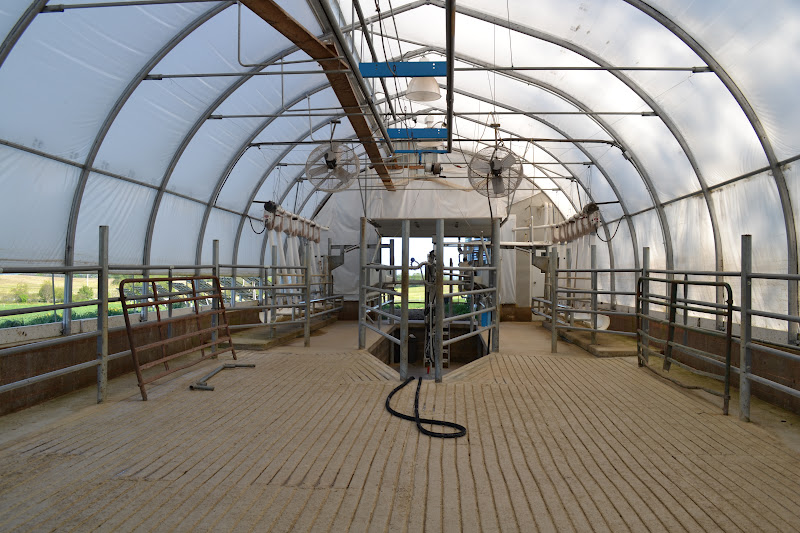
Finally, finally, I have a picture of milking-time.

As you can see, I was in the process of dipping the udders of some cows that were finished with an iodine solution that helps prevent infection. You can sort of see a milker on the last cow, towards the back.

Also note the encrusted remains of five months' worth of cow poop on my jacket sleeves.

Only one more milking session left for me, on Friday. Time sure does fly.

Friday, July 20, 2012

Regarding Poop


As a child, I remember seeing an Amish family come into a store when I was visiting my grandparents in southern Indiana.

Actually, I remember smelling them, for they smelled quite strongly of manure. And, being a fastidious child, I was mildly grossed out.

I wonder how that 10-year-old version of me would feel if she knew that, fifteen years later, she would be smelling that scent every day?

In fact, not only have I seen, smelled, and frankly touched manure almost every day this year since I began, but I have come to recognize that it is not that bad. Take the smell - something that once disgusted me is not really at all unpleasant. While certainly immediately recognizable for what it is, manure has a nutty, earthy, almost sweet scent, and probably only deeply unpleasant to those whose only experience with ordure comes when they are flushing it down a toilet.

Little do they know that manure is here to help us. Manure is our friend.

After the last two years, I consider myself something of an expert in manure. Well, maybe not an expert. A dilettante, perhaps. A dabbler, even.

It's pretty difficult to work on a farm (one with animals, that is) and not know something about manure. It's omnipresent. It gets on one's shirt, shoes, hands, and occasionally in one's hair. It must be rinsed off of equipment and pitchforked out of the barn, employing myriad tools such as high-powered hoses, latex gloves and disinfectant.

And yet, there is much to admire about manure, which has long been recognized as a delightful fertilizer.

This is one of the brilliant bits about grass-fed grazing strategy. The farmer does not need to collect the manure and truck it to the field, dispersing it with his/her tractor. What a terrible waste of time and energy and labor this is. Instead, the intelligent farmer lets the cattle takes care of distribution logistics all on its own, by liberally sprinkling the field with their castings even as they replenish their gut with yet more grass for further deposits down the road.

This, of course, is the rub. Grass-fed and free-range animal husbandry allows livestock to live in a way that does not overcrowd the land with more excreta than it can handle. Factory farming, or the practice of raising hundreds, if not thousands, of livestock together in a confined space until they reach slaughter weight, is not nearly so considerate of the earth's needs, as evidenced by the dreadful stench. Anyone who has driven behind a pig truck on the interstate can attest to this.

I thought I would close with a list of my favorite manure synonyms, garnered from Thesaurus.com:

Buffalo Chips. Cowplop. Feces. Fertilizer. Maul. Compost. Guano. Meadow Muffin. Night Soil. Egesta. Evacuation. Excrement.

Friday, July 13, 2012

Sudan Grass: A Lifesaver In July


July doesn't seem to be the best time for grass-fed cows... by this point in the year, the grasses and clover are dry and brown, parched from lack of rain and blasted by two weeks of 90-plus degree heat.

But my bovine friends need not fear, for they will be happily munching on fresh, green sudan grass next week. Sudan grass is a warm weather crop that is indigenous to (can you guess?) Eastern Africa.

Farmers who graze with sudan grass need to be a little careful, because it can be dangerous to cows when it's young, due to an overabundance of the cyanide and nitrates that make it grow. Additionally, if the grass is affected by drought and a sudden rainstorm appears, the same chemicals can show up and poison the cows.

For a farmer, making sure a grass-fed herd has access to pasture all year is a daunting proposition, and involves a lot of pre-planning. Hay needs to be grown, mown and baled. Warm weather crops must be planted weeks, sometimes months, in advance. Fences need to be put up and taken down, usually on a daily basis. Thinking of all the factors involved is like trying to solve a giant agricultural Rubik's Cube.

But the payoff can be enormous. Milk from pastured cows is demonstrably better for you - there are higher levels of fat soluble vitamins like A and D, not to mention omega 3 fatty acids, CLA's (the "good" cholesterol) and beta-carotene, which is what gives milk from grass-fed cows its delightful yellow color. What the cows eat affects the taste of their milk, as well - in my experience, pastured dairy cows produce sweeter milk than anything you will find in a grocery store.

I haven't tried it myself, but I think the cows are going to be delighted.

Friday, May 18, 2012

Cows, Cows, Cows

I feel as though this blog has been deficient in pictures of cows recently. Enjoy.


Wednesday, April 25, 2012

Milking Revisited


When I wrote a while back about the enjoyable process of milking, anyone who read that particular little post had to use their imaginations because I was sadly lacking in the picture department.

I am now happy to report that the situation has been rectified! So gaze away, my friends.


The milking parlor, all nice and clean. Picture eight cows lined up on the left and right, where they stand with their heads facing the troughs (the white bits) and their rears facing the sunken center part, where Mark and I work our milking magic. The rest of the cows hang out in the back of the parlor (where I was standing when I took this) while they wait their turn.


The food trough. Cows are bribed to stand still and let us milk them by the judicious use of grain, which comes down the plastic pipes you see along the back end of the trough.


One of the milkers. The black caps are put on because a washing/sanitizing solution is run through them before and after milking. During milking, we take those off. There are eight sets of milkers, so we start by doing the row of cows to one side, then switch over to the other side as the first batch finish.


Cows seem to take pleasure in leaving their "mark" wherever they go. So as part of clean-up, I use this gargantuan hose to gently persuade any "deposits" to evacuate down the drain at the end of the barn.


The End.

Tuesday, April 17, 2012

Her First Calf


Her First Calf
Wendell Berry


Her fate seizes her and brings her
down. She is heavy with it. It
wrings her. The great weight
is heaved out of her. It eases.
She moves into what she has become,
sure in her fate now
as a fish free in the current.
She turns to the calf who has broken
out of the womb's water and its veil.
He breathes. She licks his wet hair.
He gathers his legs under him
and rises. He stands, and his legs
wobble. After the months
of his pursuit of her, now
they meet face to face.
From the beginnings of the world
his arrival and her welcome
have been prepared. They have always
known each other.

Friday, April 13, 2012

The Truth About Cows


Cows have long eyelashes.
Cows are curious.
Cows are timorous.
Cows are great mothers.
Cows want to know what is in the bucket I'm carrying.
Cows do not moo politely.
Cows sometimes sound like angry dinosaurs.
Cows do not like it when their calves disappear.
Cows are not generous with their food.
Cows are not clean.
Cows do not hesitate to poop on whoever is behind them.
Cows like clover.
Cows disdain vetch.
Cows do not like to be touched without permission.
Cows have wet noses.
Cows have dainty ankles.
Cows eat their afterbirth.
Cows explore things (like my sweater) with their tongues.
Cows do not like the 4-wheeler.
Cows have large, luminous eyes.
Cows respond to kindness.
Cows are sneaky.
Cows think I don't hear them when they walk behind me.
Cows are creatures of habit.
Cows are superstitious.
Cows are patient.
Cows can get a little frisky.
Cows have grass stains on their knees.
Cows don't always understand death.
Cows can get depressed.
Cows are picturesque.
Cows like to be photographed.
Cows will win a staring contest.
Cows do not have a strongly developed sense of philanthropy.
Cows don't like to get their feet wet.
Cows want to know what you're doing.
Cows are methodical.
Cows are graceful, except when they're clumsy.
Cows are easily startled.
Cows like salt.
Cows hate it when they're blamed for global warming.

Friday, March 30, 2012

Udderly Delightful

The udders on a cow can tell you a great deal... how close the cow is to calving, or if she's already been milked, for example. So, feeling sort of like a pervert, I walked around and took pictures of different cow udders to illustrate this point.

When a cow gets closer to giving birth, her udders will fill and look tight with the milk that's inside. Before that, her udders will tend to look looser. Also, heifers* tend to have little udders that will become larger after a year of milking.

After milking, the udders will soften and look looser. In older cows, they will soften so much that they look like an empty leather bag. All of these pictures were taken many hours after milking in the afternoon, however.


*Heifers haven't had a calf yet, while cows have. Who knew?


Friday, March 23, 2012

The Miracle of Birth

Last week, I was taking an early evening stroll when I happened upon a cow giving birth. Since I had my trusty Nikon with me, I got some very aww-worthy pictures of the mama cow welcoming her little calf into the world.